How to stay connected with long-distance family: when the group chat isn't working
When family members live across states or oceans, endless group texts create noise without true intimacy. Here is what family psychology teaches us about intergenerational bonding, narrative identity, and 7 lasting rituals to keep distant families close.
Written by Philip · Published October 3, 2026
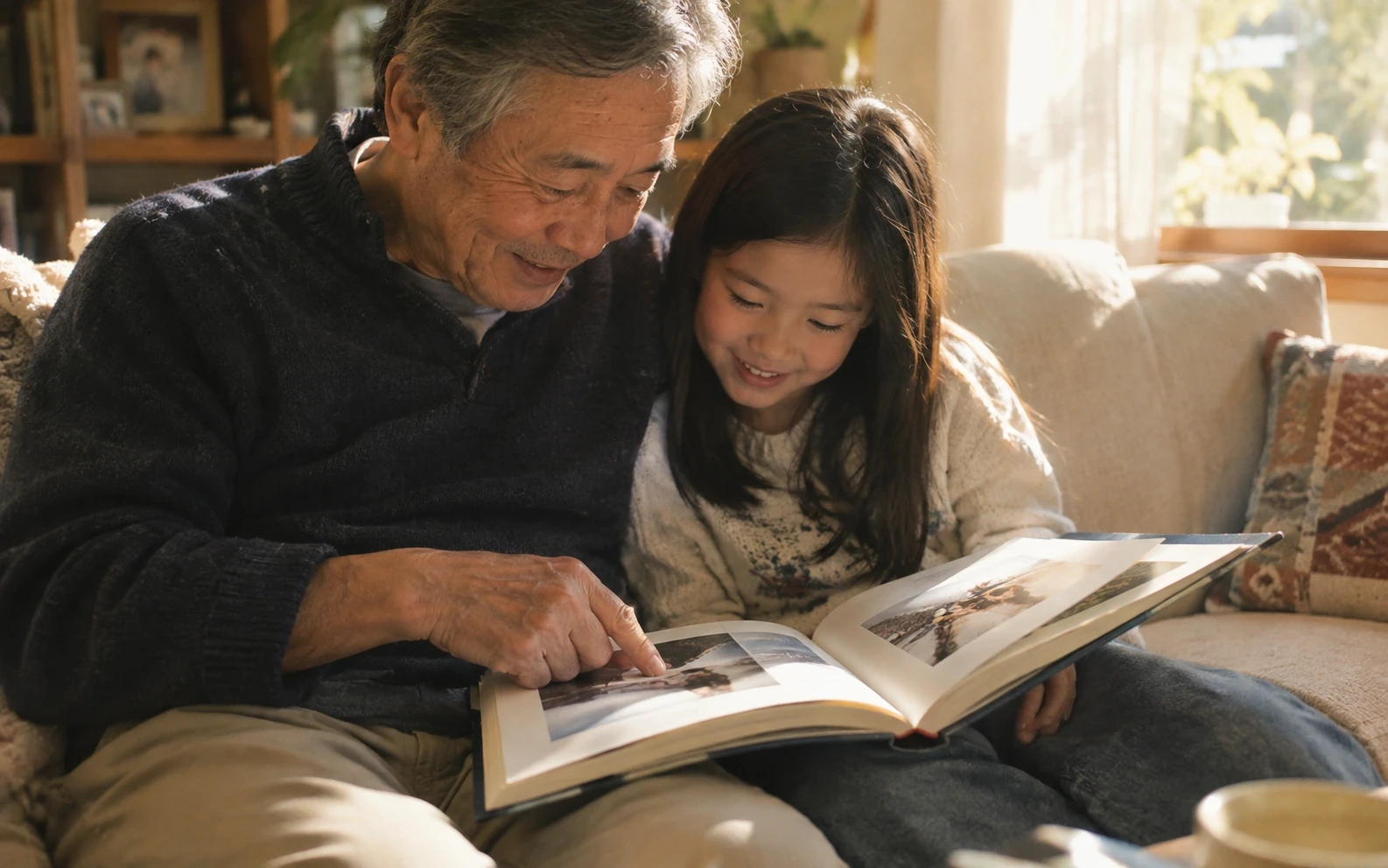
We live in the most digitally connected era in human history, yet long-distance families frequently feel emotionally isolated from one another. While photos of toddlers and grandkids can be texted in milliseconds, casual group messages fail to transmit the deeper family narrative that anchors children and sustains intergenerational love.
Here is what developmental psychology teaches us about narrative resilience in families, why group chats produce noise instead of true intimacy, and 7 structured, joyful rituals that keep distant families genuinely close.
The modern family dilemma: hyper-connected, yet emotionally distant
In modern life, geographical separation has become the default. Careers, marriages, home affordability, and education scatter siblings, parents, and grandparents across different states, time zones, and continents.
On paper, we have never possessed more powerful tools to stay in touch. A parent can snap a five-second video of their toddler taking their first steps and beam it instantaneously to grandparents living three thousand miles away.
Yet talk to almost any family separated by geography, and you will hear a quiet, persistent sadness. Despite having active family group chats on WhatsApp, iMessage, or Signal, family members often feel more emotionally detached than ever before.
People who study communication distinguish between 'ambient awareness' and 'relational depth.' Seeing a stream of casual photos or reading a text about airport delays provides ambient awareness: you know that your relatives are alive and functioning. But it provides almost zero relational depth: you do not know how they are truly feeling, what personal challenges they are navigating, or how their inner lives are evolving.
Group chats can also create a quiet pressure. Adult children feel constant guilt over unreturned messages and missed video calls. Distant grandparents feel like passive spectators scrolling past fleeting digital snapshots. And cousins growing up in different cities slowly become strangers who only exchange polite pleasantries at occasional holiday weddings.
The science of the family narrative: why shared stories build resilient kids
Why does this matter beyond nostalgia? Developmental psychology offers one answer.
In the early 2000s, psychologists Dr. Robyn Fivush and Dr. Marshall Duke at Emory University launched the Family Narrative Project to investigate how family stories influence childhood development.
They created the 'Do You Know?' scale, a twenty-question assessment that tested children on their knowledge of their family history. The questions were not about DNA or formal genealogy; they were about narrative events: Do you know where your grandparents grew up? Do you know where your parents met? Do you know about an illness or hardship someone in your family overcame? Do you know about a proud moment in your family history?
Children who knew more about their family history tended to score higher on self-esteem, showed more resilience during hard times, and reported less anxiety and depression. The findings are correlational, so they show a link, not proof that family stories cause these outcomes.
Duke and Fivush called this an 'intergenerational self': a sense of belonging to a story larger than yourself. Their suggestion was that knowing relatives faced hard times and came through them gives children something steady to lean on.
A group chat is good for quick updates, but it rarely holds onto the bigger story of who your family is.
Why group chats and social feeds fail the intergenerational bond
To fix long-distance disconnection, we must understand why our default digital tools consistently fail us.
In Reclaiming Conversation, MIT social scientist Sherry Turkle documented how mobile messaging platforms prioritize rapid, transactional connection over vulnerable, reflective conversation.
Group chats operate on an unwritten social law: keep it brief, keep it light, and keep it fast. If a grandparent wants to share a meaningful childhood memory, or an adult child wants to write a reflective update on how parenthood is changing their perspective, dropping that into a group chat feels socially awkward. Within twenty seconds, someone else in the thread will drop a sports score, a dinner photo, or a reaction GIF, burying the reflection under a mountain of conversational noise.
Furthermore, digital messaging creates severe intergenerational friction. Older family members often find rapid typing on mobile keyboards physically cumbersome or emotionally overwhelming. Rather than feeling included, elderly relatives often retreat into silence, afraid of interrupting the fast-paced flow of younger generations.
Social media broadcasts are even worse. Posting photos of children on Instagram or Facebook turns intimate family milestones into public content. Relatives consume the update as spectators in an audience rather than active participants in a private circle.
7 meaningful rituals to keep long-distance families genuinely close
Moving beyond the noise of group chats requires establishing intentional family rituals. A successful long-distance ritual must have three qualities: it must be structured, it must create space for authentic storytelling, and it must feel joyful rather than like another administrative chore.
Here are seven practical rituals that families use to stay close across distances:
1. Dedicated one-on-one bedtime story calls: Instead of chaotic whole-family video calls where everyone talks over each other, schedule a recurring twenty-minute call between a single grandparent and a grandchild. Send an identical physical children’s book to the grandparent’s house. Once a week, the grandparent reads the story over video while the child turns the matching physical pages in bed. This creates an intimate, calm ritual without parental mediation.
2. The synchronized Sunday family recipe: Food is closely tied to memory and family identity. Select a beloved traditional family recipe (a grandmother’s stew, an aunt’s holiday pastry, or a regional favorite). Pick one Sunday each month where households across the country cook the exact same meal. Over an evening call, eat dinner together, compare cooking notes, and let older relatives share the stories of who taught them the recipe.
3. The rotating postal care package or memory box: For families with young children, physical mail is still exciting. Maintain a single durable wooden box or canvas pouch that travels via mail between households every two months. Each branch of the family adds one physical artifact: a handwritten letter, pressed flowers from a garden walk, an award certificate, or printed 4x6 snapshots, before mailing it onward to the next relative.
4. Guided oral history interviews: Do not wait for a funeral to discover your parents’ and grandparents’ stories. Dedicate fifteen minutes each month to interview an older family member about one specific chapter of their life. Ask focused questions: 'What was your first job after high school?' 'What was the hardest year of your life, and how did you get through it?' 'What do you remember about the house you grew up in?' Record the audio on your phone so their real voice is preserved.
5. Digital smart photo frames (an honest appraisal): Dedicated smart frames (such as Aura or Skylight) allow family members to upload photos remotely to a grandparent’s living room. As a passive tool, they are wonderful: they provide elderly relatives with daily visual comfort. However, families should recognize their honest limitation: smart frames are a one-way broadcast. They offer ambient awareness, but they do not facilitate two-way storytelling or permanent archival preservation.
6. The annual non-holiday mini-reunion: Holiday gatherings (Thanksgiving, Christmas, or major cultural festivals) often carry immense logistical stress, travel fatigue, and packed itineraries that leave little time for genuine conversation. Consider instituting a low-pressure tradition: a quiet four-day weekend in June or September in a relaxed cabin or rental house where the only goal is cooking meals together, walking, and talking.
7. The collaborative annual family yearbook (why we built yeerbook): Many families want an annual album, but building one usually falls to a single person, who spends many hours on layout in December while everyone else watches.
We built yeerbook to make family memory-keeping a shared annual tradition. Over the course of the year, family members across different cities join a private, encrypted circle directly from their mobile browser, with zero app download or password creation required. Each month, relatives drop in a few favorite photos, write personal reflections, record thirty-second audio voice notes, and add handwritten vector signatures. At year’s end, the collective year is professionally bound into an archival A4 casebound hardcover printed on premium paper (the exact stock depends on where it ships), shipped directly to the family's chosen home with extra copies available for any household that wants one, so the year ends up in a physical book the family can keep.
Ready to turn scattered family moments into a lasting heirloom? Discover how to start a collaborative family circle where everyone from toddlers to grandparents contributes memories. You can also explore how to gift a family yearbook, build a book for your own personal reflections, create a shared volume for your friend group, or see how yeerbook works end to end.
Looking for related reading on family preservation? Explore our guides on family yearbook ideas without the chores, how circles keep in touch across distances, and why time feels like it accelerates as you get older.
Frequently asked questions
Why do family group chats feel so unsatisfying over time?
Group chats are engineered for rapid, ephemeral messaging (memes, logistics, quick links) rather than deep emotional reflection. Because the feed moves constantly, vulnerable updates feel out of place, messages quickly disappear upward in the scroll, and older relatives often feel overwhelmed by constant notifications.
How does knowing family history benefit children?
Research from Emory University’s Family Narrative Project suggests that children who know their family’s stories (how parents met, challenges grandparents overcame, family origins) tend to have higher self-esteem and more resilience when facing challenges.
How can distant grandparents bond with young grandchildren online?
Focus on focused one-on-one activities rather than chaotic group video calls. Effective rituals include reading matching physical books together over video, playing simple turn-based games, singing bedtime songs, or recording voice notes that children can listen to repeatedly.
What is ambient awareness versus relational depth in family relationships?
Ambient awareness is the surface-level knowledge that someone is alive and active (seeing a photo of their coffee or an Instagram story). Relational depth is understanding what someone is actually feeling, what challenges they are navigating, and who they are becoming. Digital tools tend to supply plenty of the first and not much of the second.
How does a collaborative family yearbook keep extended families connected?
A collaborative family yearbook transforms relatives from passive viewers into active co-authors. Rather than letting photos vanish into an endless chat stream, aunts, uncles, parents, and grandparents contribute photos, personal notes, and voice recordings into a shared annual volume that is permanently printed into an archival hardcover at year’s end.
References
- Duke, M. P., Lazarus, A., & Fivush, R. (2008). Knowledge of family history as a clinically useful index of psychological well-being and prognosis: A brief report. Psychotherapy: Theory, Research, Practice, Training, 45(2), 268-272.
- Fivush, R., Bohanek, J., & Duke, M. (2008). The intergenerational self: Subjective perspective and family history. In F. Sani (Ed.), Self continuity: Individual and collective perspectives (pp. 131-143). Psychology Press.
- Turkle, S. (2015). Reclaiming Conversation: The Power of Talk in a Digital Age. Penguin Press.
- Petrelli, D., & Whittaker, S. (2010). Family memories in the home: Contrasting physical and digital mementos. Personal and Ubiquitous Computing, 14(2), 153-169.
- Fingerman, K. L., Huo, M., & Birditt, K. S. (2020). A decade of research on intergenerational ties: Technological, economic, political, and demographic changes. Journal of Marriage and Family, 82(1), 383-403.
Bring your family closer, no matter the distance.
Start an annual family circle: invite grandparents, siblings, and children to contribute photos, handwritten signatures, and audio voice notes, delivered as a permanent archival hardcover at year’s end.
Try free for 30 days. No credit card required.
Or gift a family yearbook to parents or grandparents