Skip to content

We are all travelers: why modern life needs a physical record of crossing paths

Modern life is full of temporary places, transitions, and quiet partings. We rarely know when a meeting is our last, and the people who make a chapter meaningful deserve to be intentionally remembered.

The illusion of staying in touch

Ask anyone who has moved cities, finished university, or left a close-knit workplace what happened to the people who shared that chapter with them.

The story is often the same.

On the final night, everyone gathers around a table or on a living room floor. Glasses clink. Earnest promises are made: "We have to do an annual trip." "Text me as soon as you land." "Let us start a group chat so we never lose touch."

At first, the chat buzzes with daily jokes, photo updates, and life check-ins. Then the notifications slow down. Weeks slip between messages. Within two years, people who once knew the most intimate details of your daily life, your morning coffee routine, the person you were falling in love with, the quiet anxieties keeping you awake at night, have gradually transformed into silent avatar icons in an algorithmic feed.

You watch their lives through silent fifteen-second stories. You double-tap a vacation photo or leave a thumbs-up on a career update.

Nominally, you stayed connected. Technically, you never lost touch.

In reality, the friendship drifted away while you were watching it.
We are all travelers now

For much of history, many people lived lives that were more geographically rooted than those of many people today. But movement has always been part of human life. What has changed is the scale and frequency of the transitions we experience.

Today, we are all travelers.

Even if you never buy an international plane ticket, modern adulthood often involves a series of smaller migrations. A person might live in several cities, work across countries, change careers multiple times, or spend years building communities that eventually scatter.

You move from your hometown to a college dormitory. You move into a rented apartment with roommates who feel like family for three years. You spend four intense years building an early-stage company or working a demanding job with a small team that shares every triumph and crisis. You spend a transformative year living abroad, teaching, or working remotely. You change neighborhoods, shift careers, enter relationships, and start families.

With each transition, the cast of characters in your life shifts. People step onto your path, walk beside you for a season, and then the road diverges.

The problem is not that people leave. Change is the natural consequence of growth.

The problem is that we have forgotten how to honor the people who shared the road with us while they were here.

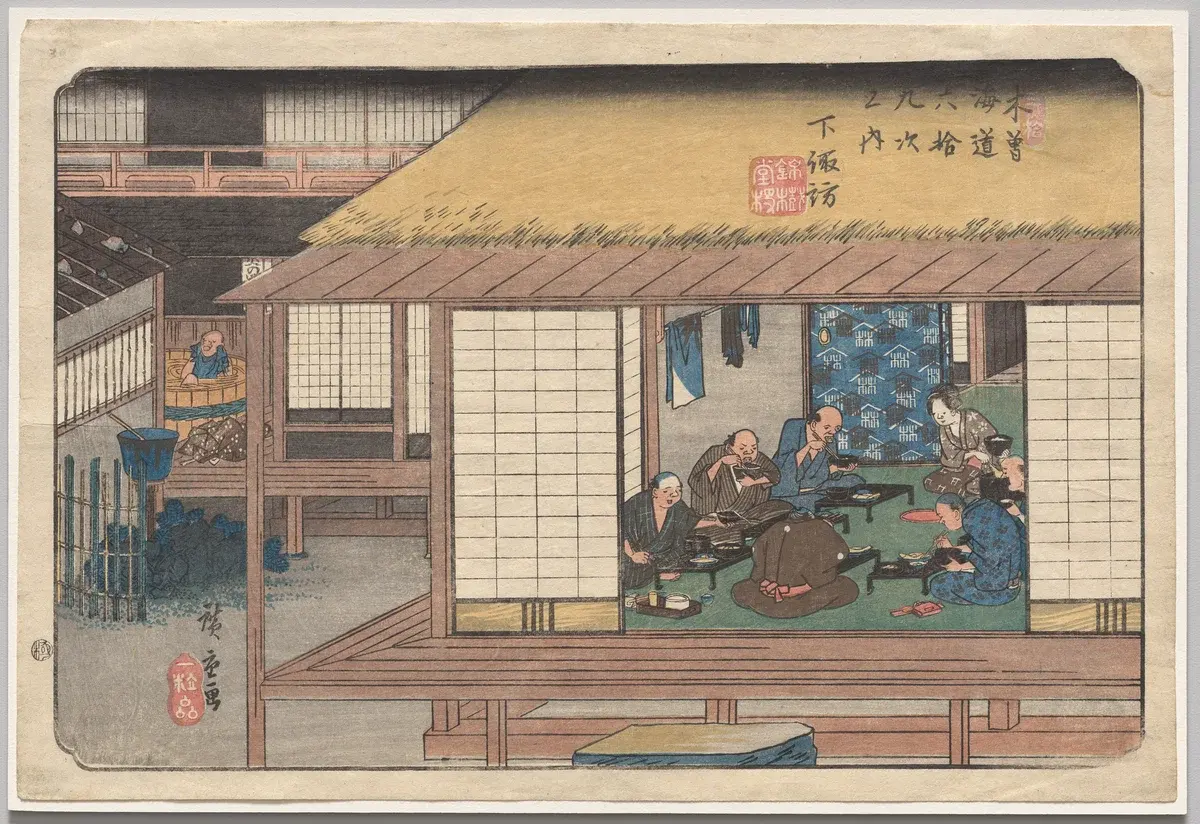
Japanese woodblock print showing travelers resting and eating together inside an open-front wooden inn along the Kisokaido highway
Shimosuwa, from Sixty-Nine Stations of the Kisokaido (c. 1835–1838) by Utagawa Hiroshige & Keisai Eisen, The Cleveland Museum of Art (1985.322).Travelers from distant provinces converge at a post-road inn along the mountain highway, offering a visual metaphor for the brief communities travelers form before their paths diverge again.

The art of crossing paths: Ichi-go Ichi-e

In classical Japanese tea philosophy, there is an enduring teaching: Ichi-go ichi-e (一期一会), traditionally translated as "one time, one meeting."

The idea is rooted in the sixteenth-century tea tradition associated with Sen no Rikyū. His disciple Yamanoue Sōji recorded the principle that a gathering should be treated as though it could happen only once in a lifetime. Centuries later, the statesman Ii Naosuke gave the idea its canonical four-character form, ichi-go ichi-e, in his 1858 tea treatise Chanoyu Ichie-shū. The idea is simple yet profound:

Even when host and guests have met many times before, this particular gathering will never happen again. The people you are today, at this specific age, in this season of your life, carrying these specific hopes and worries, will never exist in this precise combination again.

Every single encounter is an unrepeatable, once-in-a-lifetime moment.

When you look at adult friendships through this lens, the purpose of a keepsake becomes clear.

Seen through this lens, a personal yearbook does not have to be about clinging to the past or mourning that time moves forward. It can simply be an act of acknowledgment.

It is looking at a roommate, a collaborator, a partner, or a travel companion and recognizing how improbable it is that, out of all the people in the world and all the places your lives could have taken you, your paths intersected here. You lived this season together. They shaped who you are becoming. And before the current carries everyone forward, you want proof that they were here.

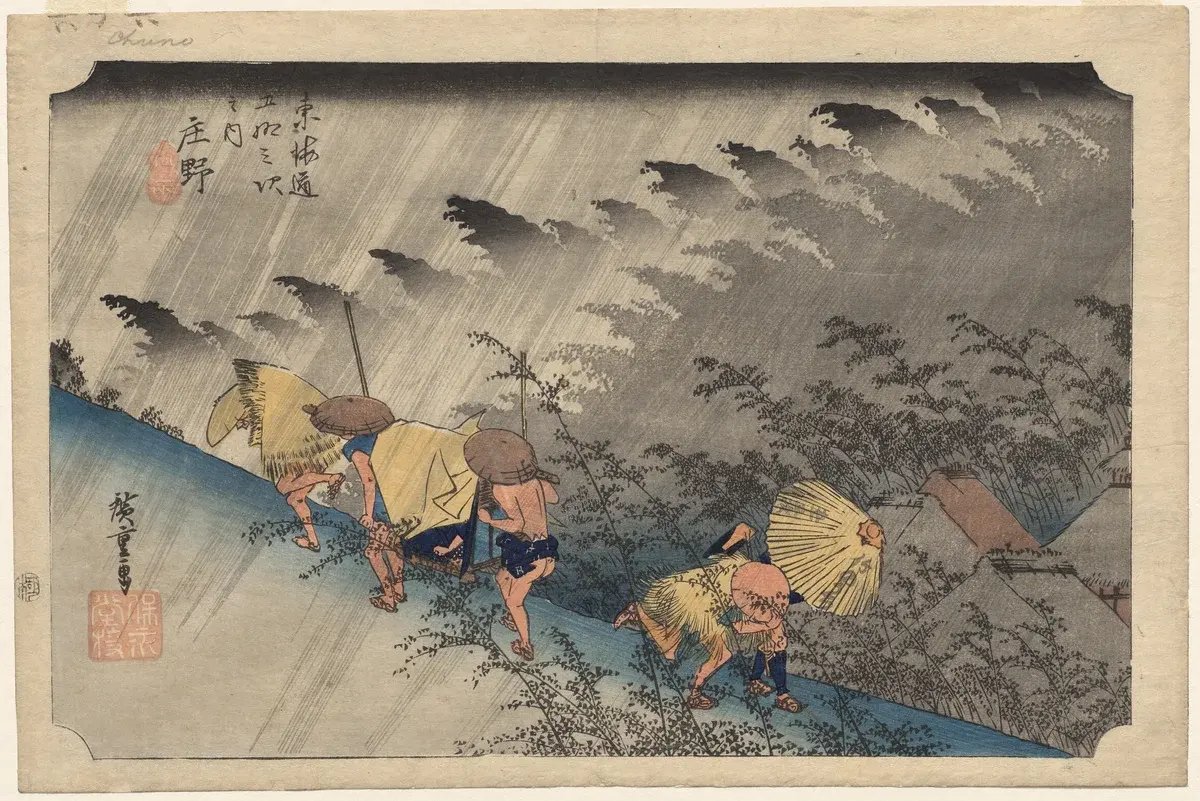
Masterpiece woodblock print of travelers hurrying in opposite directions up and down a hillside path during a fierce rainstorm
Driving Rain at Shono, from Fifty-Three Stations of the Tokaido (1833) by Utagawa Hiroshige, The Cleveland Museum of Art (1948.306).Two distinct groups of travelers hurry in opposite directions along a steep bamboo path during a sudden downpour, offering a visual metaphor for fleeting human intersections.

The tragedy of the quiet goodbye

In cinema, goodbyes are dramatic. Trains pull away from steam-filled platforms. Hands press against rainy glass windows. People run along concourses waving handkerchiefs.

In real life, partings are almost always invisible.

You grab a casual Tuesday lunch with a coworker you have laughed with every day for three years. You say, "See you tomorrow," but that evening an unexpected opportunity opens up in another city.

You hug a friend goodbye after a Sunday dinner, assuming you will hang out next weekend. But leases expire, schedules clash, life happens, and suddenly six months have passed without a single conversation.

We rarely know when a meeting is our last one.

In a widely cited study, communication researcher Jeffrey Hall estimated that moving from acquaintance to casual friendship tends to take roughly 40 to 60 hours of shared time, with deeper friendships requiring substantially more. The study also found that the kind of time matters: leisure and everyday conversation were more strongly associated with closeness than simply being physically near someone.

When people move away, what they lose is not just proximity. It is the steady accumulation of shared hours that friendship depends on.

Because modern goodbyes are so quiet, emotional drift can happen almost without anyone noticing. A conscious act of remembrance is one way of pushing back against that drift.

Intentionally asking someone to sign your book, leave a sketch, write down an inside joke, or record a personal voice note takes a fleeting Tuesday afternoon and grants it permanence.

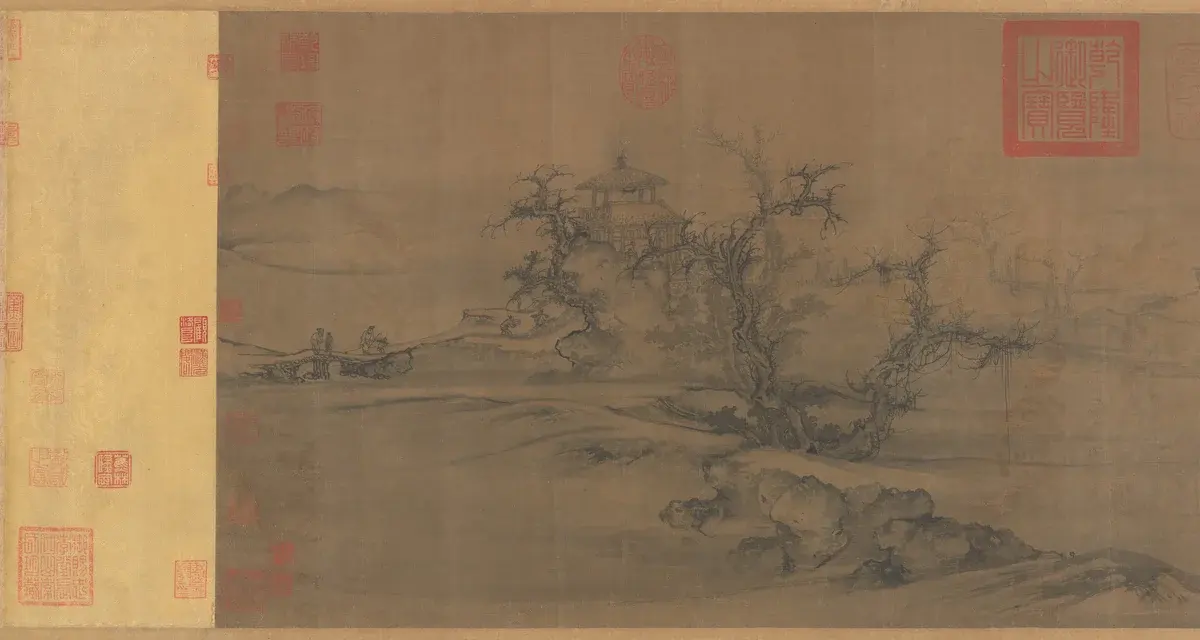
Chinese monochrome ink landscape handscroll showing scholars standing beside bare trees overlooking a wide, misty river valley
Old Trees, Level Distance (c. 1080) by Guo Xi (Northern Song Dynasty), The Metropolitan Museum of Art (1981.276 / 39668).A monumental handscroll associated with the theme of parting, portraying travelers at a misty river crossing beneath ancient trees, a timeless visual metaphor for companions at a crossroads.

Why paper can hold what a camera roll cannot

We can record almost everything now. Our phones hold tens of thousands of images, voice memos, screenshots, and videos. But recording everything is not the same as remembering well. (Why saving thousands of photos means remembering none of them)

Research by human-computer interaction researchers Daniela Petrelli, Steve Whittaker, and colleagues suggests that people often do not want an exhaustive digital archive of their lives. In their studies of family memory-keeping, participants often chose carefully selected physical objects as cues for reconstructing the past, rather than trying to preserve everything.

Digital memory is weightless. A digital photo lives on a pane of cold glass, competing with incoming work emails, breaking news alerts, and social media notifications. It is surrounded by the noise of the present moment. And because digital capture is so effortless, much of what we save never feels deliberately chosen.

A physical book operates on an entirely different emotional frequency:

First, the physical presence of the hand. A digital text message is rendered in the same clean sans-serif typeface as a bank statement or a utility bill. A handwritten note carries the unique pressure, slant, speed, and hesitation of the person who held the pen. Looking at someone's handwriting decades later feels like hearing their voice in an empty room.

Second, the dignity of constraint. A physical book has finite pages. You cannot paste ten thousand photos into it. You must select: these twelve photographs, these four stories, these eight people. That very constraint is what gives the book its enduring value.

Third, quiet physical presence. A book requires no login, no subscription, and no battery. It rests quietly on your shelf or coffee table. When you pull it down twenty years from now, your fingers touch paper where your friends once rested their hands.

A shelf of chapters

Why should graduating from high school or college be the end of the yearbook tradition? If anything, it could be only the prologue.

Adult life is not one continuous, unbroken scroll. It is a collection of distinct, self-contained chapters:

Volume 1: The Year in Lisbon.
Volume 2: The Kitchen Table Startup.
Volume 3: The Fourth-Floor Apartment on Maple Street.
Volume 4: The Year We Learned to Be Parents.
Volume 5: The Quiet Year at Home.

These chapters do not require an official committee, a class president, or a cap-and-gown ceremony to deserve a book. They deserve a book simply because they happened, and because the people who walked through them with you were real.

The people who shape a chapter of your life are often temporary. That does not make the chapter disposable.

The fact that a chapter ends does not make it less important. Often, the opposite is true.

The companion on the road

This is the reason yeerbook exists.

Not to turn adult life into a replica of high school, but to return the book to something closer to its original personal purpose: a record of the people, words, and experiences that made a chapter of your life meaningful.

With yeerbook, you choose the moments that mattered: the quiet mornings, the unglamorous milestones, your reflections, and your favorite photographs.

And like the personal books carried by students and scholars centuries ago, you can invite the people who shared that season to leave something of their own: a handwritten signature, an inside joke, a personal drawing, a photo, or a voice message recorded right from their phone.

At the close of the year, those fragments become a hardcover book.

You cannot control where the road will lead your friends next year. You cannot prevent people from moving, changing, or growing.

But before paths diverge, you can hold onto the proof that for a little while, you walked together.

Frequently asked questions

Why do adult friendships drift apart so easily after moving?

Many adult friendships do not end through dramatic conflict; they simply become harder to maintain when the shared routines, spontaneous encounters, and physical proximity that sustained them disappear. Without regular shared time, relationships can easily slip into passive social media observation rather than genuine connection.

What does Ichi-go Ichi-e mean in the context of friendship?

Ichi-go ichi-e (一期一会) is a classical Japanese concept meaning "one time, one meeting." It originated in the sixteenth-century tea ceremony tradition to remind participants that every gathering is entirely unique and will never occur in the exact same combination again. In friendship, it urges us to treat every shared season as unrepeatable and worthy of deep appreciation.

Why does a physical book preserve memory differently than digital photos?

Research in human-computer interaction shows that people reconstruct personal memories more meaningfully from selected physical cues and mementos than from exhaustive digital archives. A physical book enforces deliberate curation, turning an unmanageable stream of thousands of digital photos into a chosen, tangible narrative that engages touch and spatial permanence.

How can friends sign my yeerbook if they live in different cities?

yeerbook generates a secure, private contributor link that you can text or email to friends anywhere in the world. They can write handwritten notes, sketch doodles, place photo stickers, or record audio voice memos directly on their phone screen with their finger or stylus, without needing an account or an app download.

When is the best time to make a personal yearbook for an adult chapter?

The best time is right before a transition concludes, such as moving out of a shared apartment, wrapping up a multi-year project, completing a year abroad, or closing out a calendar year. Inviting friends to contribute while memories and emotions are still fresh captures genuine reflections that would otherwise be lost to time.

Sociological research and classical texts

  • Hall, Jeffrey A. (2018). "How many hours does it take to make a friend?" Journal of Social and Personal Relationships, 36(4), 1278-1296 (empirical research on hours and conversational depth required to build adult friendships).
  • Ii, Naosuke. (1858). Chanoyu Ichie-shu (茶の湯一会集, "Collection on the One-Time Gathering of Tea"): the canonical formulation of Ichi-go ichi-e as treating every human meeting as an unrepeatable encounter.
  • Petrelli, D., van den Hoven, E., & Whittaker, S. (2009). "Making History: Intentional Capture of Future Mementos." Human-Computer Interaction, 24(1-2), 112-148 (HCI study of personal and family mementos showing participants preferred curated physical cues over exhaustive digital capture for reconstructing the past).
  • The Cleveland Museum of Art. Accession 1985.322: Shimosuwa, from Sixty-Nine Stations of the Kisokaido (c. 1835-1838) by Utagawa Hiroshige and Keisai Eisen.
  • The Cleveland Museum of Art. Accession 1948.306: Driving Rain at Shono, from Fifty-Three Stations of the Tokaido (1833) by Utagawa Hiroshige.
  • The Metropolitan Museum of Art. Accession 1981.276 / 39668: Old Trees, Level Distance (c. 1080) by Guo Xi (Northern Song Dynasty).

Your year, signed by the people who shared the journey.

Before paths diverge, give the people who shared your journey a permanent place to leave their mark.

Start my yeerbook

Free to add your first memory. No credit card required.

Or gift a yeerbook