What is a family yearbook, and why does it bring families closer?
A family yearbook is an annual collaborative memory book co-created by immediate or extended family members across generations and distances. Here is what family psychology teaches us about intergenerational narratives, keeping distant relatives close, and preserving a living family heirloom.
Written by Philip · Published October 4, 2026 · Updated October 6, 2026
In modern life, geographical separation has become the default. Careers, marriages, college, and housing costs scatter siblings, parents, and grandparents across different states, time zones, and continents.
On paper, we have never possessed more ways to stay in touch. A family group chat buzzes all day with photos of kids, quick updates, and holiday plans. Yet talk to almost any family living apart, and you will hear a quiet, persistent ache: despite constant digital pings, family members often feel more emotionally detached than ever before.
An annual family yearbook offers an enduring alternative. Rather than letting another year dissolve into ephemeral chat bubbles and lost camera rolls, it brings immediate or extended family members together into a shared, physical volume that preserves both the moments celebrated together and the personal chapters lived apart.
The short definition
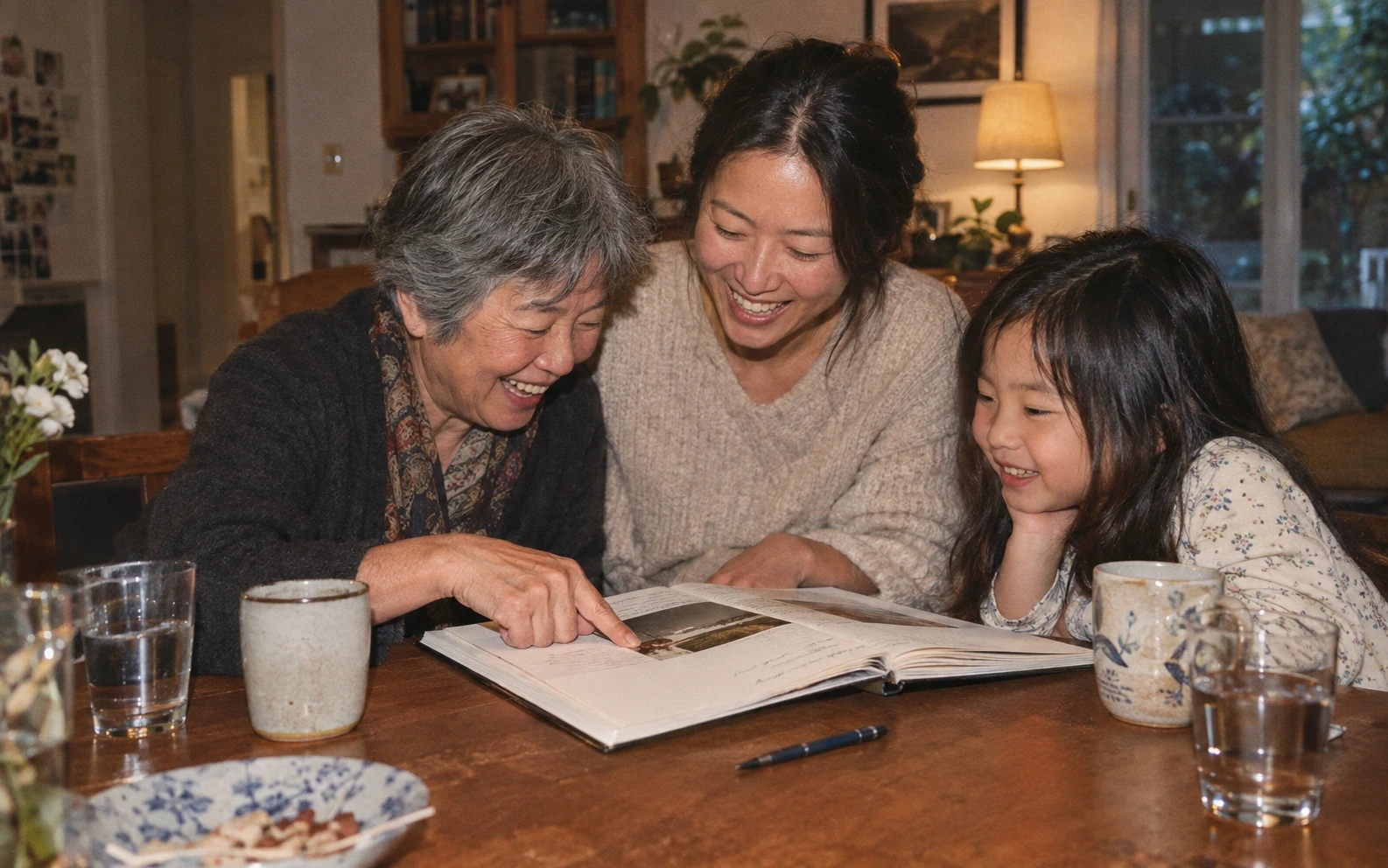
A family yearbook is an annual collaborative memory book co-created by immediate or extended family members across generations and distances. It captures both the milestone gatherings shared together (holidays, birthdays, reunions) and the personal chapters lived apart (everyday routines, personal milestones, quiet updates), preserving the living intergenerational family narrative into a permanent printed volume.
Unlike a traditional school yearbook created by a student committee for hundreds of classmates, a family yearbook belongs entirely to your family circle. You decide which moments mattered, which voices are included, and what stories deserve a permanent place on the family bookshelf.
It also differs fundamentally from an individual personal yearbook. While a personal yearbook is centered on your own individual growth and private peer signing links, a family yearbook is co-authored by multiple generations (parents, adult children, grandparents, aunts, uncles, and cousins) who share an enduring family story.
The two halves of a family yearbook: shared gatherings and the moments in between
When most people think of a family album, they naturally think of the rare occasions everyone spent under one roof: Thanksgiving dinner, a summer beach reunion, or a wedding.
Those gatherings are vital anchors. But in adulthood, families spend the vast majority of the year living separate lives in different households. The real reason family connections thin out across time is not a lack of love; it is that daily life happens in the quiet space between those rare gatherings.
A true family yearbook is built around both halves of family life:
1. The moments shared together: The annual reunion, holiday meals, road trips, and celebratory toasts.
2. The chapters lived in between: The first day of second grade, a kitchen renovation, a new pet, retirement garden mornings, everyday struggles, and the quiet milestones that distant grandparents, aunts, and uncles rarely get to witness in person.
By documenting the in-between months alongside the shared gatherings, a family yearbook stops being a static event souvenir and becomes an intimate, living chronicle of who your family is becoming.
The science of the family narrative: why shared stories build resilient kids
Why does this matter beyond nostalgia? Developmental psychology offers one answer.
In the early 2000s, psychologists Dr. Robyn Fivush and Dr. Marshall Duke at Emory University launched the Family Narrative Project to investigate how family stories influence childhood development.
They developed the "Do You Know?" scale, asking children twenty questions about their family history: where their grandparents grew up, how their parents met, a hardship a relative overcame, and proud moments in their family past.
Children who knew more about their family history tended to score higher on self-esteem, showed more resilience during hard times, and reported less anxiety and depression. The findings are correlational, so they show a link, not proof that family stories cause these outcomes.
Duke and Fivush called this an "intergenerational self": a sense of belonging to a story larger than yourself. Their suggestion was that knowing relatives faced hard times and came through them gives children something steady to lean on.
A family yearbook provides the physical vessel for this intergenerational narrative. It turns fragmented family lore into a tangible heirloom that children can hold, revisit, and absorb year after year.
Why family group chats and shared albums fail the intergenerational bond
When families want to stay connected across distances, they default to digital tools: WhatsApp, iMessage, or shared photo streams.
They are convenient for everyday logistics, but they rarely build much depth:
Awareness vs. depth: Writers and researchers describe a gap between "ambient awareness" (you know someone is alive and active) and real depth (you know what they are feeling and how they are changing). In Reclaiming Conversation, MIT professor Sherry Turkle argues that constant messaging tends to crowd out the slower conversations where that depth comes from.
The disposable chat stream: Group chats demand speed and brevity. If a grandparent writes a thoughtful reflection or a parent shares an honest reflection on the hardships of raising toddlers, that message is buried within minutes under sports scores, memes, or logistical chatter.
Intergenerational friction: Typing on small mobile screens is physically cumbersome for older relatives. Grandparents often retreat into silence, feeling like passive bystanders scrolling past younger generations.
The digital dumping ground: Shared photo streams accumulate hundreds of uncurated, duplicate photos that nobody ever organizes, prints, or flips through again.
Why traditional photo books break down (the solo parent burden)
Many families recognize this digital void and resolve to make an annual photo album. Yet traditional photo book platforms add a lot of friction.
The work usually falls on a single tired family member: often one parent who spends many hours in late December chasing photos by email, wrestling with layout tools, and guessing captions for relatives they haven't seen in months.
Because the process is solitary, the rest of the family remains passive spectators. When memory-keeping becomes an exhausting administrative chore, it rarely survives as a multi-year tradition.
A modern family yearbook solves this through effortless collaboration: every household contributes their own memories, reflections, and voices throughout the year, distributing the joy rather than dumping the work on one person.
What does a family yearbook contain?
There are no rigid rules for a family yearbook, but the most cherished volumes balance visual candids with authentic personal voices:
Month-by-month family timeline: Candid photos from everyday life that prevent the year from blurring into routine.
Grandparent memories and voice notes: Reflections, stories of growing up, and recorded spoken audio that preserves their real voice for future generations.
Children's milestones and artwork: First steps, school drawings, handwritten notes, and quotes that capture fleeting childhood stages.
Shared reunion chapters: A dedicated spread celebrating the annual family gathering, holiday trip, or anniversary.
Handwritten notes and doodles: Vector signatures and margin notes drawn by family members directly on the pages.
How yeerbook brings the family yearbook to life
yeerbook was built to make family memory-keeping a shared, low-effort habit.
No app downloads or accounts: Family members join a private, encrypted circle directly from their mobile browser with a private link. Grandparents and cousins can contribute without remembering passwords or navigating an app store.
Asynchronous, low-stress contributions: Family members drop in photos, short reflections, and thirty-second audio voice notes whenever life happens throughout the year.
Real handwriting: With a finger or stylus on their phone, relatives can draw handwritten messages and doodles directly on shared pages.
Archival printed hardcover: At year's end, the collective memories compile into a durable A4 casebound matte hardcover with interior pages printed on archival-quality paper (the exact stock depends on where it ships). The primary book ships directly to whichever address the family organizer chooses, and any relative or household can easily order an additional copy delivered straight to their doorstep.
Who makes a family yearbook?
Long-distance families
Parents, adult children, and grandparents living in different cities or time zones who want to stay genuinely involved in each other’s daily lives between visits, moving beyond fragmented group texts.
Read about staying connected across distanceGrowing families with young children
Parents who want to preserve the fleeting stages of childhood before they slip away, while giving distant grandparents, aunts, and uncles an effortless way to follow along and contribute their own voices.
Learn more about preserving early childhoodAdult siblings staying connected with aging parents
Siblings scattered into separate adult households who want to keep the family story close: giving parents and adult children a shared space to post meaningful updates, reflections, everyday moments, and audio memories while staying part of each other’s lives.
Explore family prompts and storytelling themesFamilies with an annual reunion
Turning the annual gathering into an enduring tradition: unboxing, reviewing, and signing the physical book together around the table with pens, and taking a family photo with the finished book to become the opening memory for next year’s volume.
Learn more about yeerbook for familiesLooking for practical themes, monthly prompt ideas, and page structures? Read our guide on family yearbook ideas. To explore how to preserve an individual personal journey, explore what a personal yearbook is or see how yeerbook works.
Frequently asked questions
What is the difference between a family photo album and a family yearbook?
A photo album is typically a collection of photos from a single event or vacation, curated by one person. A family yearbook is a collaborative annual chronicle co-created by multiple generations, preserving both shared gatherings and everyday life lived apart with stories, reflections, handwriting, and audio.
How do long-distance relatives contribute to a family yearbook?
Family members receive a private web link on their phones. They can upload photos, type reflections, record short voice notes, or write handwritten notes directly from their browser without downloading an app or creating an account.
How does a family yearbook help children build emotional resilience?
Research from Emory University’s Family Narrative Project suggests that children who know their family's stories tend to have higher self-esteem and more resilience during setbacks. Researchers think this is partly because they see themselves as part of a larger story.
What if older grandparents are not tech-savvy?
yeerbook requires no logins, apps, or complex software. Grandparents can open a simple link in their mobile browser to view photos, record a voice note, or write a note with their finger.
How does ordering and shipping work for a family circle?
Each family circle includes one printed A4 casebound hardcover book, shipped directly to whichever address the organizer chooses (such as the family home or grandparents’ house). Any other family member or branch of the family can easily order additional copies shipped directly to their own home.
References
- Duke, M. P., Lazarus, A., & Fivush, R. (2008). Knowledge of family history as a clinically useful index of psychological well-being and prognosis: A brief report. Psychotherapy: Theory, Research, Practice, Training, 45(2), 268-272.
- Fivush, R., Bohanek, J., & Duke, M. (2008). The intergenerational self: Subjective perspective and family history. In F. Sani (Ed.), Self continuity: Individual and collective perspectives (pp. 131-143). Psychology Press.
- Turkle, S. (2015). Reclaiming Conversation: The Power of Talk in a Digital Age. Penguin Press.
- Petrelli, D., & Whittaker, S. (2010). Family memories in the home: Contrasting physical and digital mementos. Personal and Ubiquitous Computing, 14(2), 153-169.
- Fingerman, K. L., Huo, M., & Birditt, K. S. (2020). A decade of research on intergenerational ties: Technological, economic, political, and demographic changes. Journal of Marriage and Family, 82(1), 383-403.
Your family's year, bound into one living heirloom.
No twenty-hour December layout sprint. Just your family's favorite photos, handwritten notes, and real voices preserved for generations.
Try free for 30 days. No credit card required.